About Our Melbourne Window Cleaning Company
Commercial buildings only, worked by technicians who are certified for height rather than trained on the job. Insurance, method statements and anchor records are part of the quote, not something produced after a question.

- Commercialbuildings only
- Certifiedfor rope work
- Documentssent with the quote
Commercial Window Cleaning Melbourne is a commercial window cleaning company working across the metropolitan area, from CBD towers and Docklands curtain wall through to suburban offices, strata buildings, shopfronts and factories. We clean glass on buildings. We do not do houses, and we do not do general office cleaning, which is a deliberate choice rather than a gap.
Staying narrow is what lets us keep certified height technicians on staff instead of hiring them in. A company that cleans everything has to treat rope access as an occasional subcontract. A company that only cleans commercial glass can carry the gear, the training and the insurance as a normal running cost, and that difference shows up in how quickly a building gets quoted and how the work is actually done.
If you landed here to check whether we are a real business before sending an address, this page is the short version: who we are, what the crew is certified to do, what insurance we carry and how the paperwork works. The services themselves are listed on commercial window cleaning in Melbourne.
Who runs this commercial window cleaning company?
An ABN registered Melbourne business, run by the people who price the buildings rather than by a call centre. Commercial glass is all we do, and the person who quotes your site is the person who sees it through.
Accountability is the reason a page like this exists at all. On height work, whoever quoted the building should be whoever you can raise a problem with, and on a crew this size that is realistic rather than a slogan. Quotes come from a person, not a generic inbox, and that person stays on the job through to the invoice.
We work across greater Melbourne rather than one corridor, because access equipment and certified crews travel better than they sit idle. In practice that means regular work in the CBD, Docklands, Southbank and St Kilda Road, and a steady run of buildings through South Melbourne, Port Melbourne and the inner industrial belt.
There is no call centre and no franchise layer. When you send a building through, it goes to the person who will assess it, and if we are not the right contractor for it we say so rather than quoting something we would rather not do.
- Owner run, not a franchise or a call centre.
- Melbourne based, working the whole metropolitan area.
- ABN registered and verifiable on request.
- One point of contact from quote through to invoice.
What is the crew actually certified to do?
Rope technicians are IRATA certified, and every rope job runs with a qualified supervisor on site. Platform operators hold a current high risk work licence for the machines they run.
Rope access is governed by a system rather than a skill. IRATA certification sets what a technician can do unsupervised, who has to be present, and how a rescue is planned before anyone goes over an edge. It is the reason a rope crew is safer on a facade than a ladder is on a single storey, and it is the first thing a building manager should ask about.
Boom and scissor lift work needs its own licensing, and in Victoria that means a high risk work licence for boom-type platforms over eleven metres. Operators carry theirs, and machine logbooks and pre-start records are available if your site wants them filed before work starts.
Training is not a one-off. Certifications expire, rescue drills get practised rather than written down once, and equipment is inspected on a schedule with the records kept. Anyone can say they are certified. What matters is whether the date on the card is current, which is why we send the cards with the quote instead of waiting to be asked.
What insurance and compliance do you carry?
Public liability insurance, WorkCover for employees, and a method statement drafted around your building rather than copied from the last one. The certificate of currency goes out with the quote, so nothing about our cover has to be taken on trust.
- Certificate of currencyShows who underwrites us, for how much and until when, sent with the quote rather than produced on request.
- Safe work method statementWritten for the building being cleaned, naming its access method, anchors, exclusion zones and rescue plan.
- Anchor and equipment recordsAnchor certification checked before rope work, with rope gear inspected on schedule and retired to date.
- Toolbox processA short on-site talk before each job covering that day's hazards, not a form signed in the van.
The point of a document pack is that somebody can check it. A certificate of currency can be verified with the insurer. An anchor certificate has a date and an engineer's name on it. A method statement that mentions your building's roof layout was clearly written after somebody looked at your roof. Generic paperwork tells you the opposite, and it is common enough that it is worth reading rather than filing.
Victoria's rules on working at height apply to window cleaning the same way they apply to any trade, and they are stricter than most building managers expect. For what the regulations demand, and how a compliant job looks from the client side, read window cleaning safety and compliance in Victoria.
How do you work on a building?
Assess first, quote in writing, agree the access method, then clean to that scope. Anything that changes gets raised before it happens rather than appearing on an invoice afterwards.
Most disputes in this trade come from scope rather than quality. One side assumed the rear elevation was included, the other priced three faces, and nobody wrote it down. So our quotes name the elevations, say whether the inside is covered, and list what is excluded in words rather than leaving it implied.
On site, the pattern is the same on every job. Set up and check access, run the toolbox talk, work top down so nothing dirties what has been finished, then walk the ground level at the end. If wind stops rope work partway through, the remaining elevations are rebooked at the same price rather than requoted.
Afterwards you get a short close-out: what was done, anything we noticed on the facade, and anything that could not be completed with the reason. That record is what makes the next visit faster, and on a program it becomes a history of the building's glass that nobody else is keeping.
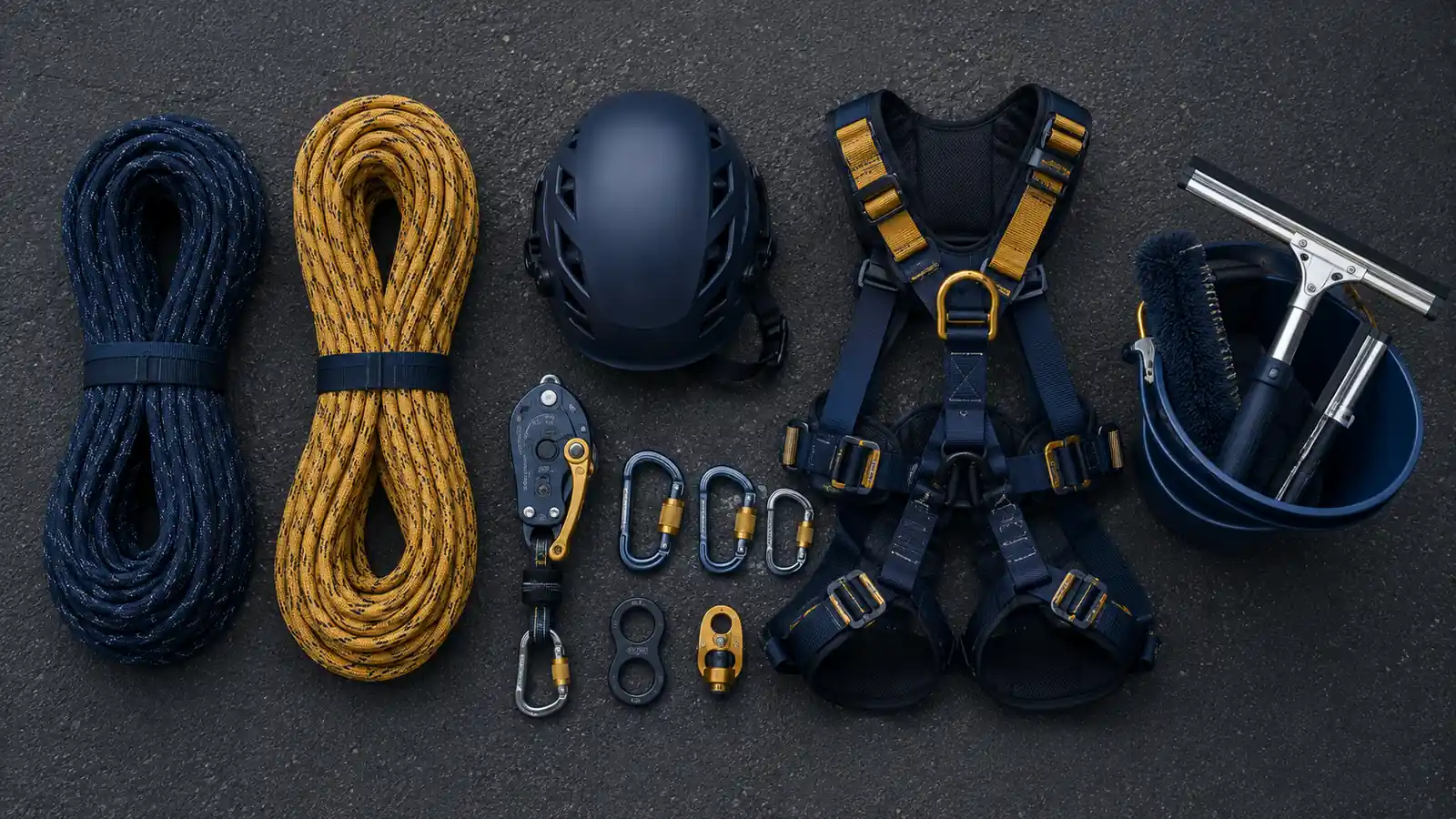 Gear inspected and recorded before it goes on a building
Why commercial buildings only?
Because the equipment, certification and insurance that commercial work needs are a poor fit for houses, and a contractor who does both usually does one of them as a sideline.
A domestic round and a rope access crew are different businesses wearing the same name. One is priced in half hours and driven by volume, the other is priced in days and driven by access planning and paperwork. Trying to run both means the equipment sits idle half the week and the height certifications get treated as an expense rather than the core of the business.
Being commercial only also changes who we answer to. Facility managers, building owners, strata committees and retail operations teams all want the same three things: a scope in writing, documents that check out, and work that happens when it was promised. That is a narrower brief than the domestic market and it suits us.
The practical result for you is that nothing on this site is a stretch. Every building type listed is one we work on regularly, and if your site needs something outside that, the honest answer is a referral rather than a quote.
What do you need from us to start?
An address, a rough idea of the height and how the glass is reached, and what you want cleaned. Everything else we work out, including whether your building needs a site visit.
Ask for the insurance and method statement at the same time. Both go out with the price rather than after it. Send the details through get a quote and you will have a written figure back within a day.
- Certificate of currency sent with every quote.
- Method statement written for your building.
- Certified technicians, not casual labour at height.
- Scope and exclusions in writing before anyone starts.