
Building and Facade Window Cleaning in Melbourne
The two to eight storey middle of the market: medical suites, showrooms, small office blocks, schools and converted warehouses. Cleaned from the footpath with purified water, no ladders, no machine in the car park unless the facade demands one.
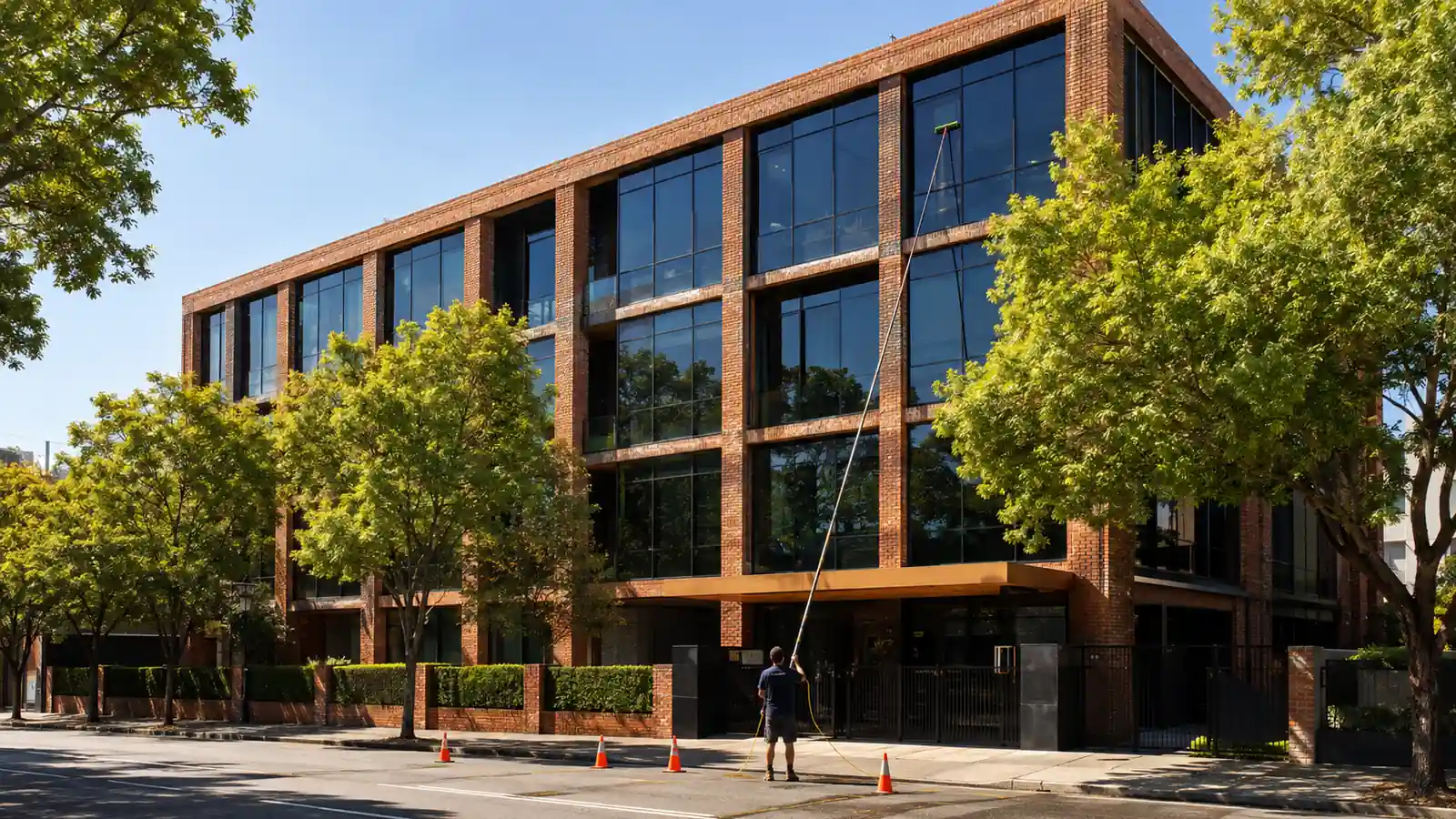
- 2 to 8storeys
- 20 mtypical pole reach
- 0ladders used
Building window cleaning covers everything between a shopfront and a tower: the two to eight storey stock that makes up most of commercial Melbourne and almost never gets talked about. Medical centres in Clayton, showrooms in South Melbourne, small office blocks along the arterials, schools, gyms, converted warehouses in the inner north. None of them need a rope crew. All of them need someone who can reach the top floor safely.
The work is done from the ground with a water-fed pole, which is a carbon fibre pole carrying purified water to a brush at the glass. Nobody climbs, nothing leans against the building, and the water dries without leaving marks. If a planted courtyard, a deep recess or glazing hanging over a void puts panes beyond the reach of a pole, that part of the elevation is done from a platform.
The people who book it are usually property managers with a few buildings, owners of a single asset, or the tenant who got tired of looking through grime. If your building is taller than this, or the facade is complicated enough to need a rope, that is a different job and it is covered elsewhere. Our window cleaning services page shows which is which.
Which buildings does this actually suit?
Anything from two to about eight storeys with a facade that can be seen from the ground. That includes suburban offices, medical and dental centres, showrooms, schools, childcare buildings, gyms and small mixed-use blocks.
- Suburban officesTwo to five storeys with a car park at the base and glass on every elevation.
- Medical and dentalStreet-level entries and waiting rooms where the glass is at patient eye level.
- ShowroomsTall single-storey glazing that behaves like a shopfront but reaches six metres.
- Converted warehousesOlder frames, high windows and skylights that nobody has reached in years.
What these have in common is that the glass is reachable but not easily. It is too high for a person with a squeegee and a bucket, too low to justify a rope crew, and often in a spot where a machine cannot stand. That gap is exactly what pole work was designed for, and it is where most of our weekly workload sits.
Schools and childcare buildings deserve a note of their own. Both have glass at child height that gets touched constantly, high windows nobody can reach, and rules about who may be on site and when. Holiday periods solve most of it, and pole work solves the rest, since there is no ladder to fall from and no detergent running into a playground.
Owners sometimes ask whether a general cleaner could do the same job with a ladder. They could try, and plenty do. Working from a ladder at that height is the single riskiest thing on a commercial cleaning site, and it is entirely avoidable now that poles reach as far as they do. We do not carry ladders for facade work at all.
 Purified water, soft brush, no contact with the building and nobody off the ground
Why does a water-fed pole leave no streaks?
Because the water has had its minerals stripped out before it reaches the glass. Ordinary tap water dries and leaves those minerals behind as spots. Purified water has nothing left in it to leave.
The system filters mains water down to almost nothing dissolved, then pumps it through the pole to a soft brush at the top. The brush agitates the dirt, the flow of water carries it off the pane, and the glass is left to dry on its own. No squeegee, no cloth, no ladder, and no hands on the building.
Two things decide whether it works properly. The water has to be genuinely pure, which means testing and changing the filter media rather than assuming. And the rinse has to be thorough, because dirt loosened but not washed off will dry exactly where it sits. A rushed pole job looks worse than no job at all, which is why the technique has a mixed reputation among people who have been burned by one.
Reach is the practical limit. On a still day the working limit is roughly eighteen to twenty metres, which comfortably covers five or six storeys. Beyond that the pole becomes hard to control and wind makes it worse, so we switch methods rather than push it.
What happens on facades a pole cannot reach?
A work platform goes in for that section. Deep setbacks, internal courtyards, glass above an awning or a lower roof, and atrium glazing all need the technician taken to the pane rather than reaching for it.
The requirement is ground that can take the machine. A scissor lift needs a firm level surface, a boom needs room to set its legs, and both need a path in that is wide enough. Car parks usually work. Planted courtyards and suspended slabs over basements often do not, and that is a question for the building's engineer rather than for us.
Where a boom of eleven metres or more is used, the operator holds a WP class high risk work licence. It is worth asking any contractor for that ticket before a machine turns up, because hiring a lift is easy and being licensed to operate one is not.
The cost sits mostly in the hire and the setup rather than the cleaning, which is why we try to design it out. On a lot of buildings, one awkward elevation is the only part that needs a platform, so we quote that section separately and you can decide whether it is worth doing every visit or once a year.
- Deep setbacks where the pole cannot get a clear line to the glass.
- Internal courtyards with no access for anything on wheels except through the building.
- Glass over awnings or a lower roof, where there is nothing to stand beside.
- Atriums and voids inside the building, usually done on a weekend.
- Sawtooth roof glazing on older warehouse conversions.
What counts as the facade?
The glass, the frames around it, the sills beneath it and the panels between floors. Entry doors and their surrounds are included, and so is any glass at ground level that people put their hands on.
Frames and sills are where cheap quotes quietly stop. Cleaning a pane and leaving the frame gives you a clean window for about a week, because the next shower washes the grit off the frame straight down the glass. Anyone who has watched a facade streak three days after a clean has seen exactly that happen.
Signage is the other grey area. Glass beside a sign, behind a sign, or forming the sign itself is usually cleaned as part of the elevation, but illuminated boxes and vinyl-wrapped panels are not, because the wrong cloth on a printed film will ruin it. We ask before the first visit and note the answer on the file so every crew after that knows.
Spandrel panels, the opaque sections between floors on a curtain wall, are part of the elevation too. They are not glass you look through, but they are glass you look at, and leaving them dirty while the vision panels are clean creates a striped building that looks worse than it did before.
A first clean on a neglected facade usually turns up things nobody knew were there: silicone runs left by a glazier, paint specks from the last repaint, adhesive from signage that came down years ago, and hard water marks where a sprinkler has been hitting the same pane twice a day. We photograph what we find and tell you, rather than attacking it with a blade and hoping. Some of it comes off with more time. Some of it needs a glazier, and knowing which is which saves money.
What we exclude, and say so in the quote, is anything structural or specialised: sealant repair, cracked panes, film and tinting work, and mineral etching that has been left long enough to bond into the surface. We will tell you when we see it, because the sooner a building knows about etched glass the cheaper it is to deal with.
"Are frames and sills in the price?" is the fastest way to compare two facade quotes honestly. If one is cheaper and the answer is no, you are comparing a clean facade against a clean pane, and they are not the same product.
How do portfolios get handled?
As one schedule with one rate structure. Property managers with several buildings get the sites grouped by suburb and run in sequence, so travel time is shared and each building costs less than it would alone.
The saving is real but it comes from routing, not from a discount. Four buildings in the same corridor cleaned across two days costs less than four separate mobilisations, because the crew, the gear and the water are already there. Spread the same four across the metro area and the saving mostly disappears.
Reporting is what property managers actually ask for. One schedule showing every building and its next visit, one invoice format, and a short note after each site confirming what was done. Where an owner wants their own paperwork, we can split the invoicing by asset without splitting the crew.
Annual planning is the other thing portfolio managers ask for. Once the calendar is set, we can tell you what the year costs per asset before the budget is signed off, which makes glass one of the few line items that does not move mid-year. If a building is sold or a lease changes hands, it comes off the schedule without unwinding the rest.
New buildings coming under management slot into the existing calendar rather than starting a fresh procurement each time. The way a year of visits is laid out and costed appears under scheduled window cleaning programs.
 Grouped by suburb, sequenced across the year, one report format for every site
When does a building need the rope crew instead?
Once the glass is beyond about 20 metres, or when a stepped, recessed or overhanging elevation hides panes from the ground no matter how long the pole gets.
Ground conditions can force the same decision from the other direction. A building only five storeys tall, but wrapped by a suspended slab over a basement car park, may have no surface that can take a platform and no line for a pole. In that case the roof becomes the only viable anchor point and the job moves to the rope crew despite the modest height.
Height is the obvious trigger. The less obvious one is shape. A seven storey building with a flat front is straightforward pole work. The same building with a stepped profile, a light well down the middle and glass set behind balconies has sections no pole will ever see, and pretending otherwise just leaves them dirty.
The honest version of this conversation happens at quoting stage. We will tell you which parts of your facade the pole covers and which parts need a rope or a platform, then price the mix. What we will not do is quote the whole building at pole rates and then discover the problem on the day, which is how most facade jobs go over budget.
Where rope turns out to be the answer, the requirements behind it sit under high rise window cleaning, and the mechanics of a descent are explained in how high rise windows are cleaned.
What does building window cleaning cost at this size?
Far less than people expect, because pole work is quick and needs no machinery. The number comes from how many elevations there are, how much glass sits on each, and whether any part needs a platform.
A compact four storey building with glass on two sides is a half-day job for two technicians. The same footprint with glass on all four elevations, a courtyard and a setback is a full day plus a platform hire. The building looks similar from the street; the quotes are not similar at all.
One more thing worth budgeting for on older stock: the first visit often needs two technicians where later ones need one. Nothing about the building has changed, but the amount of work on each pane has, and pretending the first clean will run at maintenance speed only produces a rushed result. We quote the first visit honestly and the rate drops from the second one onward.
Frequency moves it the same way it moves everything else. The first clean on a facade that has been left for years takes the longest, because the grime has bonded and needs working rather than rinsing. After that, a building on a quarterly or twice-yearly round cleans faster each time and the rate reflects it.
Water access matters more than people expect on this size of building. A tap near the elevation makes a job straightforward. No tap means carrying water in, which adds time to every visit and shows up in the rate. It is a five second question at quoting stage and it changes the number more often than the height does.
Access restrictions are the last factor. A building where the crew can park beside the elevation and work through the morning is cheaper than one where every hose run crosses a public footpath and the work has to happen before trading starts. Every one of those factors is set out, service by service, under commercial window cleaning cost.
How do you get your building priced?
Send the address, how many storeys, and which elevations have glass. A photo of each side is better than a paragraph, and with those we can quote most buildings of this size without visiting.
The price covers the facade as a whole, frames and sills included, with any platform section listed separately so you can see what it adds. Ready when you are: get a quote, or see the full picture on commercial window cleaning in Melbourne.
- Frames and sills are in the price, not an extra line.
- Any section needing a platform is priced on its own.
- Portfolios grouped by suburb to keep travel out of the rate.
- No ladders on any facade job, at any height.