Window Cleaning Safety and Compliance in Victoria
What a compliant job looks like from the client's side of the fence: who carries the duty, what documents mean something, and which questions separate a contractor who has the system from one who has the paperwork.
- Shared dutyowner, manager and contractor
- SWMSspecific to your building
- Verifyeverything against WorkSafe
High rise window cleaning safety is not only the contractor's problem, and that is the single most useful thing a building manager can understand. Victorian workplace law places duties on the people who control a workplace as well as on the people performing the work, so engaging somebody to hang off your building does not transfer the whole obligation to them.
This guide describes what compliant work looks like in practice and what to ask for before signing anything. It is written for facility managers, owners corporation committees and building owners, in the order those decisions actually arrive.
None of it is legal advice and it should not stand in for any. Duties, regulations and standards move, and WorkSafe Victoria is the authority for what applies in this state, so read their published guidance before relying on anything written here. Every other explanation we have written for building managers sits on the commercial window cleaning guides hub.
Who actually holds the duty for high rise window cleaning safety?
Everyone with control over some part of it, at the same time. The contractor is responsible for their own workers and methods, and whoever controls the building carries duties that engaging a contractor does not extinguish.
Australian workplace law does not work on a single point of blame. Duties overlap deliberately, so that a building owner, a managing agent and a contractor can all hold obligations for the same activity, each to the extent they influence it. What that means for a building manager is that choosing a contractor is itself part of discharging the duty.
In practice the division is reasonably clear. The contractor plans the work, trains and supervises their people, provides equipment and writes the method. The building side provides accurate information about the structure, maintains the things it owns such as anchors and cradles, and makes sure the contractor engaged is competent and insured.
The failure mode is predictable. A building accepts the cheapest quote without documents, something happens, and the investigation asks what the person controlling the workplace did to satisfy themselves the contractor was capable. Having asked for nothing is not a defence.
- The contractor plans, trains, supervises and equips.
- The building maintains anchors, cradles and access it owns.
- Both share information about hazards the other cannot see.
- Choosing well is itself part of the duty, not preliminary to it.
- Check with WorkSafe Victoria for what applies to your situation.
What does a real method statement contain?
Your building, by name, with its own hazards, its own access method and its own rescue plan. A statement that could be handed to any client on any street is a template, not a method statement.
| Look for | What good looks like | What should worry you |
|---|---|---|
| The building | Named, with its actual layout described | Generic wording with your name inserted |
| The hazards | Specific to this site and this facade | A list that would fit any job anywhere |
| The access method | Stated for each elevation | Vague phrasing such as height access as required |
| The rescue plan | Names roles, equipment and a time | Call emergency services, and nothing further |
| Controls | Tied to each hazard identified | A standing list of PPE with no link to the hazards |
| Who wrote and reviewed it | Named people and a recent date | No author, no date, or a date years old |
You do not need safety qualifications to assess this. Read it as a document about your building and ask whether somebody who had actually stood on your roof could have written it. If the answer is no, the document is decoration, and decoration does not help anyone on the day something goes wrong.
High risk construction work in Victoria attracts specific documentation requirements, and work at height falls within that category. What exactly is required, and when, is set out in WorkSafe Victoria's guidance rather than here, and it is worth reading directly rather than through a contractor's summary of it.
Who is responsible for the anchor points?
The building, not the contractor. Anchors are part of the structure, they are inspected and certified on a cycle, and keeping that current sits with whoever owns or manages the property.
This is the compliance gap we encounter most often. A building assumes its window cleaner deals with anchors. The window cleaner assumes the building does. Certification lapses, and the first anyone knows is a crew declining to work on arrival, which is the correct outcome but an expensive way to discover it.
The Australian standard covering fall-arrest equipment sets how often an anchor system must be examined and signed off, and the industry generally works to a yearly cycle. Whoever certifies yours puts their name on the paperwork. Ask them what interval applies to your particular system rather than assuming, since it shifts with the installation and its condition.
The practical step is simple. Find out today when your anchors were last certified and put the next date in the maintenance calendar, alongside the cradle inspection if the building has one. Both are structural obligations that continue whether or not anybody books a window clean.
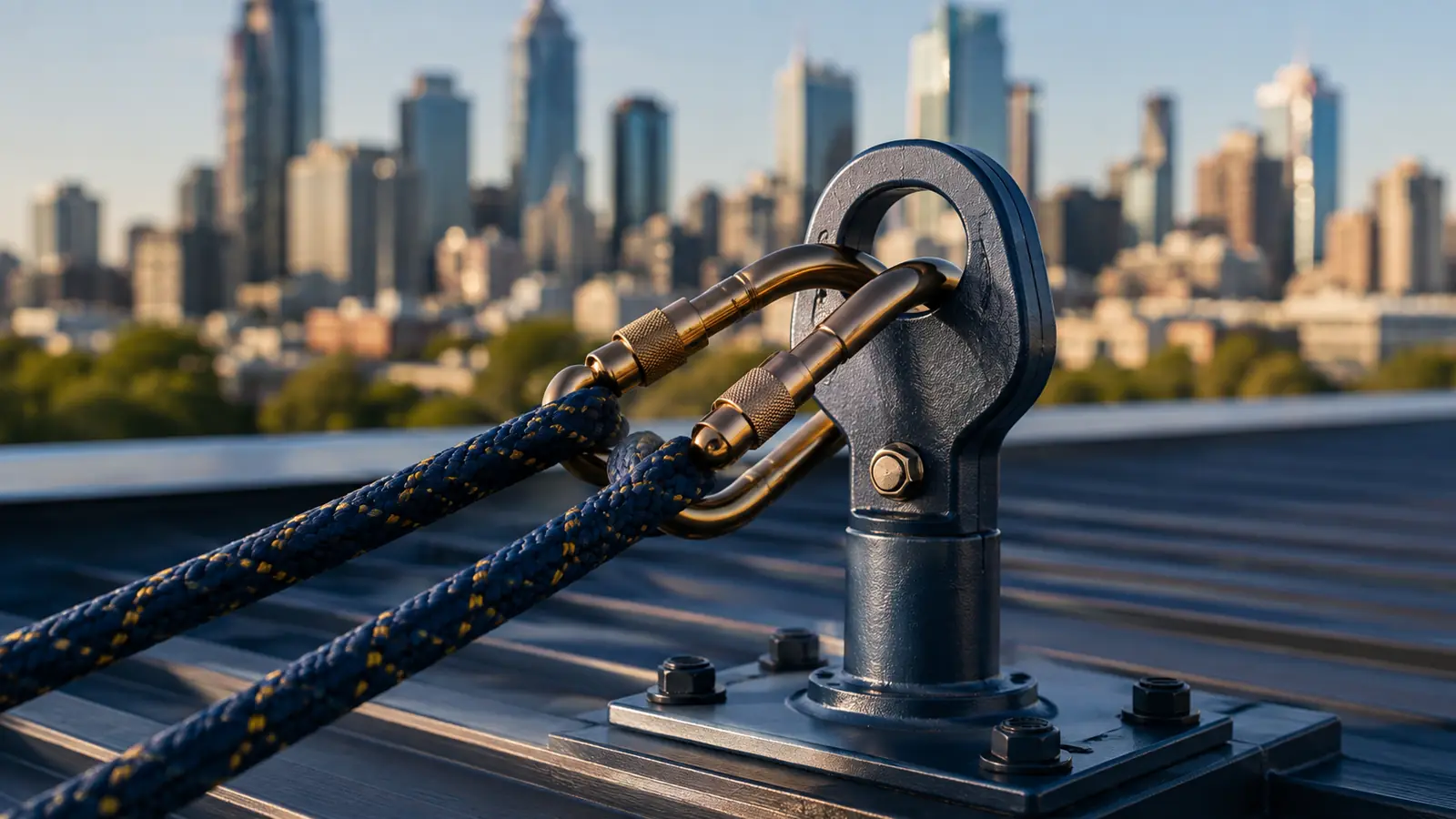 Anchors belong to the building, and so does keeping their certification current
How should the public below be protected?
With an exclusion zone under every drop, sized to the height of the work, barriered and usually spotted. Anything falling from a facade reaches the ground faster than a person can react to it.
Dropped objects are the main risk that height work poses to people who are not doing it. A small tool released from twenty floors up carries serious energy by the time it lands, which is why tethering is standard and why the ground beneath is controlled rather than simply watched.
Zone size is not arbitrary. The higher the work, the wider the area that needs excluding, because objects do not fall in a straight line once wind is involved. A crew that has set barriers a metre from the building on a tall facade has not thought about it properly.
In a busy street the zone needs a person as well as a barrier. Pedestrians move cones, step over bunting and walk under scaffolding without looking up, and a spotter is the only control that reliably deals with that. On a quiet loading dock, barriers alone may be reasonable.
Where the ground cannot be controlled at all, the honest answer is to change the timing rather than proceed. Early mornings, evenings and weekends exist for exactly this reason, and a contractor who would rather work over a crowded footpath than move the booking has told you something about their judgement.
What insurance should you actually sight?
A current certificate of currency for public liability, and evidence of WorkCover cover for employees. Sighted, not described, and checked for the expiry date rather than the letterhead.
Public liability responds to damage or injury the contractor causes to others, which on a facade job is the exposure that matters to a building. The certificate names the insurer, the policy, the sum insured and the period, and any of those being absent is a reason to ask for a better document.
WorkCover covers the contractor's own workers. Its relevance to you is indirect but real: a contractor operating without it is either not employing people properly or not running a compliant business, and neither is the sort of operation you want on your roof.
The mistake worth avoiding is accepting a certificate once and never looking again. Policies lapse, sums change and businesses restructure. On a program that runs for years, asking annually takes one email and closes a gap that nobody notices until it matters.
- Certificate of currency, not a statement that cover exists.
- Check the expiry, because the letterhead is not the point.
- WorkCover evidence for anyone employing workers.
- Ask again annually on any ongoing arrangement.
- Keep a copy on file with the method statement.
What should you check before engaging anyone?
Six things, all of which a competent contractor can produce within a day. If any of them takes a week or arrives as an explanation instead of a document, that is the answer.
- Certificate of currencyCurrent, naming the insurer and the period, and matching the entity on the quote.
- Certification for the methodRope technician cards with dates, or a licence for the platform being used.
- A site-specific method statementAbout your building, with a rescue plan that names roles and timings.
- Anchor status confirmedWhose responsibility it is, when it was last certified, and what happens if it has lapsed.
- A written scopeElevations, inclusions, exclusions and the number of visits, so nothing is assumed.
- A weather policyWhat happens to the price when wind stops the job halfway through.
None of these are unreasonable requests and none should cause friction. Contractors who work on commercial buildings regularly have all six ready to send, because every other client asks. Hesitation at this stage is worth taking seriously.
How to weigh the answers once you have them, and what a quote's price is really telling you, is covered in how to choose a commercial window cleaner.
How do we handle this ourselves?
Documents go out with the quote rather than on request, method statements are written for the building being cleaned, and anchor status is checked before a rope price is given rather than after.
You are welcome to hold us to the same checklist above. Our approach is described under about us, and you can ask for the whole pack through get a quote.
- Insurance and method statement attached to the price.
- Anchor status raised before quoting, not after booking.
- Exclusion zones sized to the height, with a spotter in public areas.
- Work stopped for weather, and rebooked at the agreed figure.