
How High Rise Windows Are Cleaned
Four methods, one decision. This is what each one involves, what it costs you in disruption, and how the choice gets made for a particular building rather than a particular contractor.

- Four methodsand no universal answer
- The building decidesnot the contractor
- Purified wateris why glass dries clear
Anyone who has stood at the base of a tower and wondered how to clean high rise buildings windows has asked a reasonable question, because from the footpath the answer is not obvious. There are only four practical methods, and which one a building gets is determined almost entirely by how it was designed rather than by anything a cleaning company prefers.
This matters commercially, not just technically. The method is the single largest component of what you pay, so a quote that does not name it is not really a quote. Two contractors pricing the same facade by different methods will produce numbers that look inexplicably far apart until you know which is which.
What follows is each method, its limits, and the logic that picks between them. The rest of the explanations for building managers sit on our commercial window cleaning guides hub.
What are the four ways to clean high rise buildings windows?
The tower's own building maintenance unit, rope access off certified roof anchors, an elevating work platform brought in at street level, or a water-fed pole where the glass sits within reach of the footpath.
| Method | Reaches | Needs | Disruption |
|---|---|---|---|
| Building maintenance unit | The whole facade it was designed for | A current inspection and a trained operator | Almost none, it lives on the roof |
| Rope access | Any elevation, to any height | Certified anchors and a Level 3 supervisor | An exclusion zone below each drop |
| Elevating work platform | Depends on the machine, tens of metres | Ground that carries it, often a permit | Occupies ground space for the whole job |
| Water-fed pole | Roughly eight metres from the ground | Somewhere to park within hose reach | Minimal, no barriers in most cases |
Most towers end up using two of these rather than one. The facade goes on rope or a cradle, and the podium, entry and ground level go on a pole, because sending a rope technician to clean a shopfront makes no sense. A quote that covers a whole building should say which method applies to which part of it.
There is no fifth option worth mentioning. Ladders are not used on commercial buildings above single storey, and anyone proposing one for facade work has told you everything you need to know.
What is a building maintenance unit and who has one?
A cradle permanently installed on the roof, running on a track or a davit arm, that lowers workers down the facade. Premium and purpose-built towers usually have one. Older and smaller buildings usually do not.
When a building has one and it is in inspection, it is normally the cheapest way to clean that facade, because the access equipment is already there and already paid for. The cleaning contractor supplies trained operators rather than machinery.
Two things regularly stop it being used. The first is certification: a unit out of inspection cannot legally be operated, and getting it recertified is an engineering job with a lead time. The second is coverage. Plenty of units were designed to reach most of a facade rather than all of it, leaving returns, setbacks and atria that still need rope.
If your building has a cradle, the useful question for a contractor is not whether they will use it but whether their operators are trained on that specific unit. They vary considerably, and familiarity is the difference between a smooth day and a slow one.
- Cheapest where it exists and is in inspection.
- Certification lapses stop it more often than mechanical faults.
- Rarely covers everything, so rope fills the gaps.
- Operator training is unit-specific, not general.
Where does rope access fit in?
It is the default for towers without a cradle, and the backup for towers that have one. Nothing else reaches every part of a complicated facade at reasonable cost.
The working pattern is straightforward once you have watched it. A technician rigs at the roof, descends one line of glass washing as they go, reaches the ground, returns to the roof, shifts the ropes sideways and repeats. A crew of two typically runs several of those lines a day, weather permitting.
What makes it flexible is that the equipment does not have to be positioned at ground level. Setbacks, light wells, curved elevations and rear faces hemmed in by neighbouring buildings are all reachable, which is exactly where platforms run out of options.
Its limits are anchors and weather. No certified anchors means no rope work until an engineer resolves it, and wind stops the job at speeds that feel unremarkable from the street. Both are covered in detail in what is rope access.
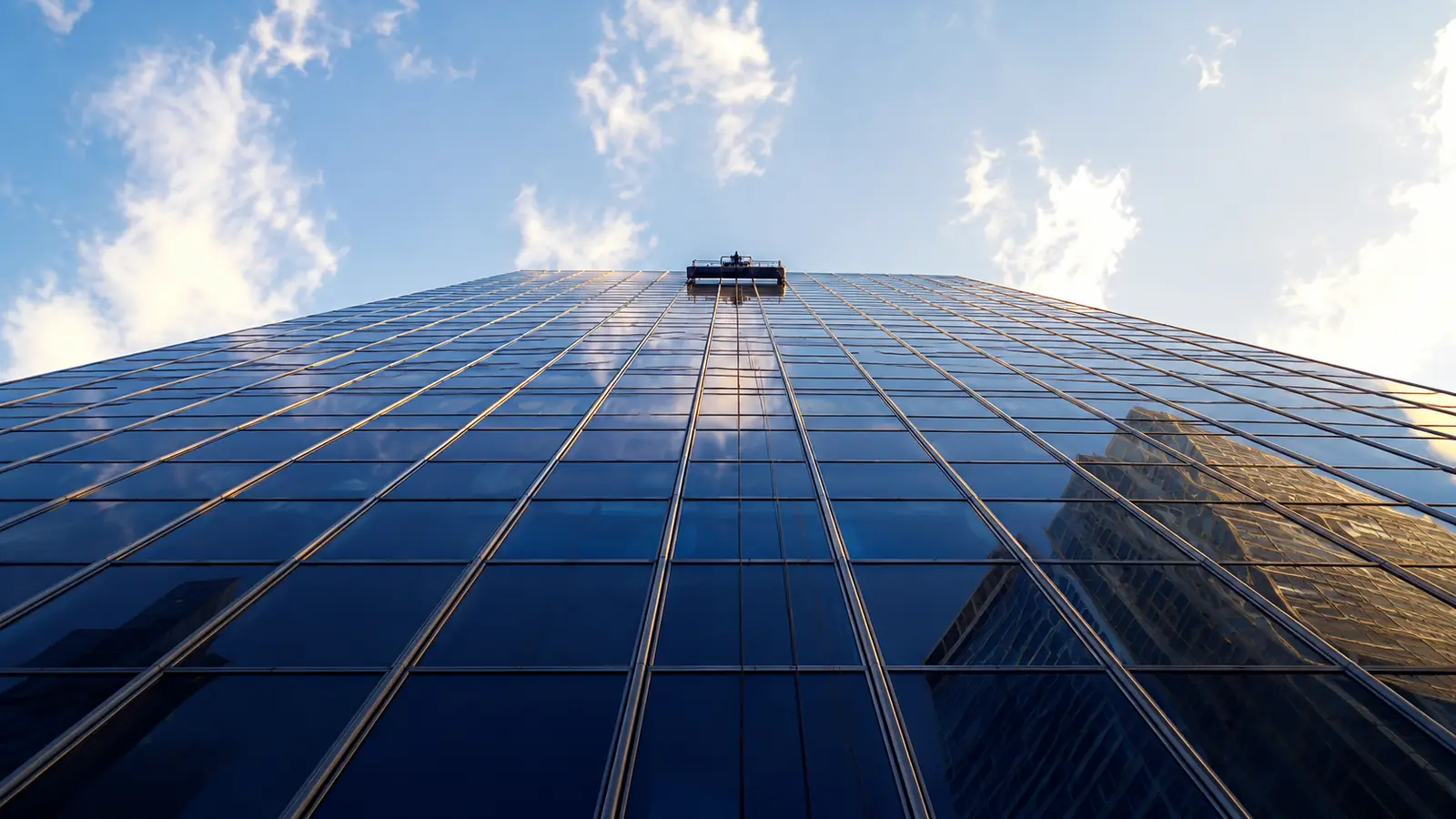 Rope reaches the parts of a facade a machine on the ground cannot
Why are platforms harder to use in Melbourne?
Because most city buildings meet the footpath, and a machine standing on a footpath or a traffic lane needs council approval, a traffic management plan and a slot in a queue.
Inside the Hoddle Grid, ground space is the scarcest thing there is. Trams, loading zones, bike lanes and construction hoardings already compete for it, so occupying a lane to clean windows is treated as seriously as any other works, with the same paperwork and the same lead time.
Outside the grid it changes completely. A building set back behind its own driveway, forecourt or car park can take a machine on private land with no permit at all, which is why platform work is common on office boulevards and industrial estates and rare in the city centre.
The other constraint is what the ground will carry. A boom lift is heavy, and forecourts over basement car parks are frequently not designed for that load. Where the slab is in doubt, the honest answer is an engineering check rather than an optimistic guess, and plenty of jobs move to rope on the strength of it.
Scissor lifts are the indoor cousin, used for atrium and internal high glass where the floor is solid and level. They are quiet, quick and need no permit, which makes internal void glazing far cheaper to maintain than most building managers expect.
How does a water-fed pole leave glass clear?
By washing with water that has had its minerals stripped out, then leaving it to dry rather than squeegeeing. With nothing dissolved in the water, there is nothing left behind to dry as a spot.
Tap water carries dissolved solids, and those are what you see when a window dries badly. Filter and deionise it until barely anything remains, and that same water will rinse a pane and evaporate off it leaving no trace at all. That is the entire principle.
The pole itself is carbon fibre with a brush on the end, fed from a tank in the vehicle. It reaches roughly eight metres comfortably, which covers a two or three storey building entirely and the lower levels of anything taller.
Its limits are honest ones. Above that height the pole becomes hard to control and the finish suffers. It also cannot remove bonded contamination such as silicone, paint or adhesive, which still needs a technician close enough to work on the pane by hand.
- No ladders and nobody working above the footpath.
- Frames and sills get washed at the same time.
- Stops at about eight metres, honestly stated.
- Will not shift silicone, paint or adhesive.
- Bottom metre still finished by hand where it shows.
How is the method chosen for a particular building?
By eliminating the ones the building rules out, in order: installed system first, then ground conditions, then anchors, then height. Whatever survives is the method, and usually only one does.
- Is there a cradle, in inspection?If yes, use it for everything it reaches, and price the remainder separately.
- Can a machine stand on the ground?Private land, adequate slab and enough room usually means a platform beats rope on cost.
- Are there certified anchors?Where the ground says no, anchors decide whether rope access is available at all.
- Is any of it under eight metres?Podium, entry and shopfront glass goes on a pole regardless of what the tower above uses.
Run that sequence on your own building and you will usually land in the same place a contractor does. If two quotes reach different answers, one of them has skipped a step, and the cheaper one is not automatically the culprit. Sometimes the dearer quote is simply the one that priced the rear elevation nobody else looked at.
Facade condition changes the work but rarely the method. Hard water staining, construction residue and neglected sills all add time, and a first clean after years of nothing is always slower than the visits that follow. How that plays out on real buildings is covered under building and facade window cleaning.
How do you find out what your building needs?
Have it assessed. On anything above about eight storeys that means somebody looking at the roof, because the roof answers three of the four questions in one visit.
An assessment costs nothing, and the written method arrives alongside the figure. Put your address into get a quote, or see how each method runs day to day under high rise window cleaning.
- The method named in the quote, elevation by elevation.
- Anchor and cradle status checked, not assumed.
- Podium and tower priced as separate lines.
- An honest answer where the method we prefer is not the right one.