
What Is Rope Access Window Cleaning?
The method most building managers worry about, and the one governed more tightly than any other kind of height work. Here is what actually happens on the rope, and what the system around it is designed to prevent.
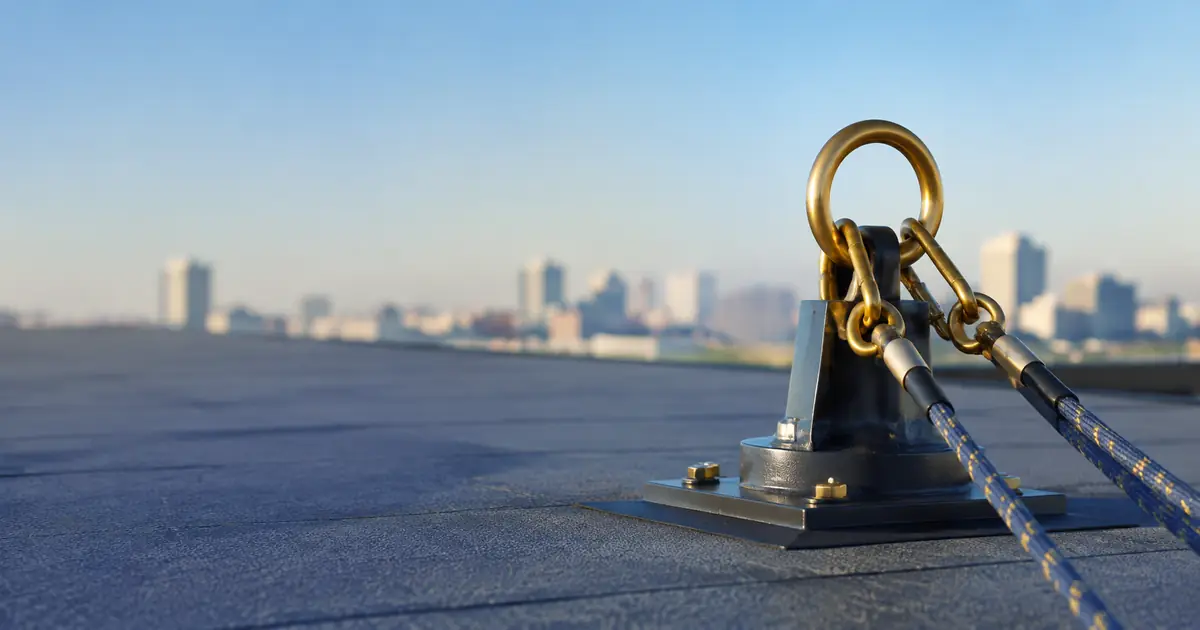
- Two ropesalways, never one
- Certifiedtechnicians and supervisors
- Rescue planwritten before anyone descends
Rope access window cleaning is a technician descending the outside of a building on two independent ropes, washing one vertical band of glass as they go, then climbing back to the parapet and shifting sideways for the next band. It is the same discipline used to inspect bridges, maintain wind turbines and work on offshore platforms, applied to a facade.
People hear the description and picture abseiling, which is understandable and misleading. Recreational abseiling uses one rope and relies on the person. Industrial rope access uses two, with the second holding the technician if the first fails, and it sits inside a system of certification, supervision, inspection and rescue planning that has no equivalent in the recreational version.
That system is the point of this guide. Not because it makes interesting reading, but because a building manager who understands it can tell in one phone call whether a contractor is running it properly. If you want the shorter commercial version instead, our commercial window cleaning guides hub links everything by the question it answers.
What is rope access window cleaning in one paragraph?
A trained technician suspended from certified roof anchors on two ropes, working down a facade under a supervisor, to a written plan that includes how they would be recovered if something went wrong.
Every part of that sentence is doing work. Trained means certified by an assessment body rather than shown the ropes on site. Certified anchors means somebody competent has confirmed the steel will hold and written it down with a date. Two ropes means a working line and a backup that is independent of it.
Under a supervisor means a more senior technician is present and responsible for the job, not sitting in an office. And a written plan means the rescue was thought through before the descent rather than improvised during one, which is the part that separates a professional operation from a risky one.
The cleaning itself is ordinary. Applicator, squeegee, detail cloth, exactly as at ground level. Everything difficult about rope access is the arrangement that puts a person safely in front of the glass.
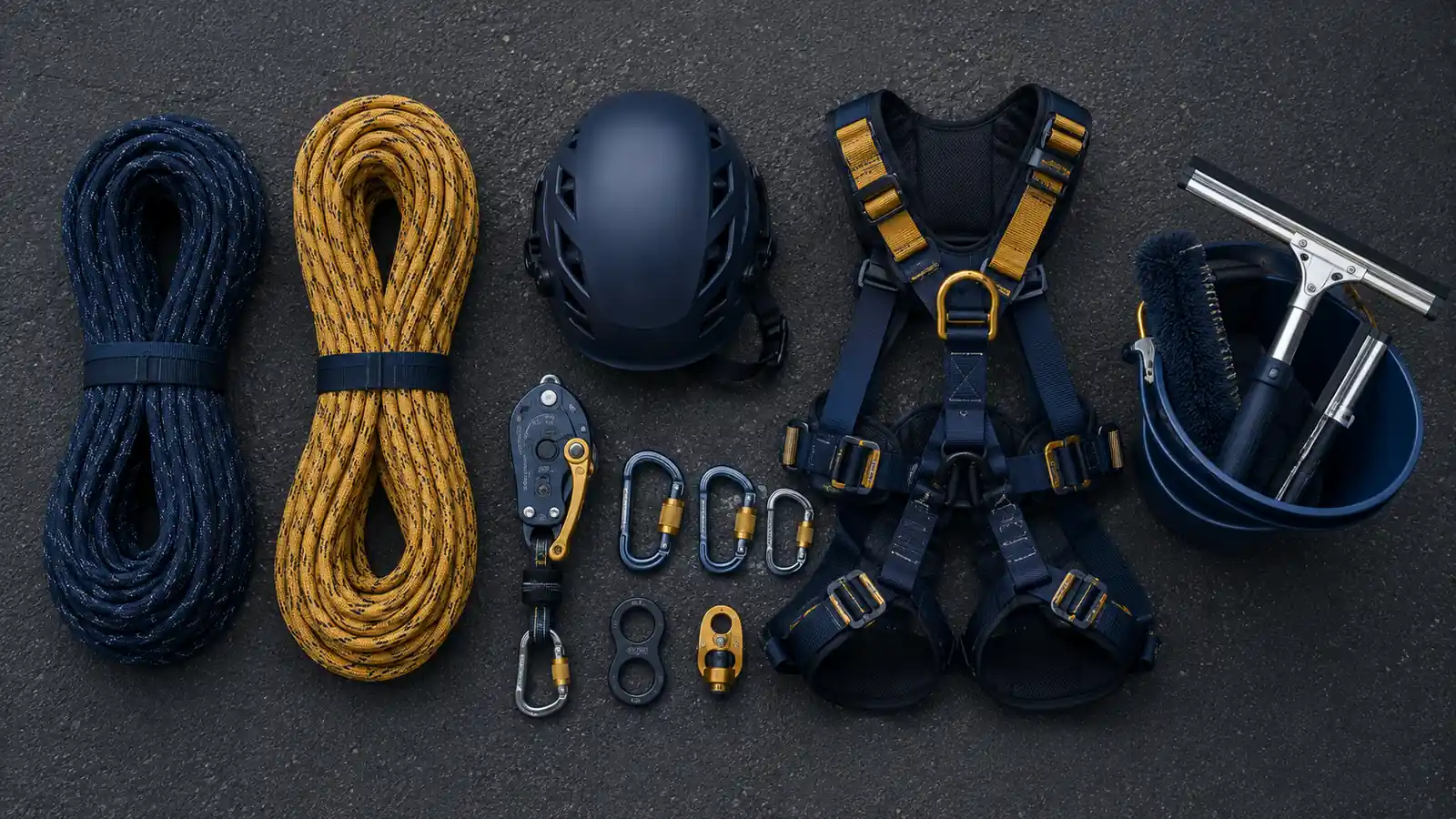 Everything difficult about the method happens before anyone touches glass
Why two ropes instead of one?
Because one rope is a single point of failure and the entire method is built to have none. The working line carries the technician, and a separate backup line with its own device and its own anchor catches them if it does not.
The two ropes do different jobs. The working line runs through a descender that the technician controls, letting them move down at whatever pace the glass needs and stop wherever they like. The backup line runs through a fall-arrest device that sits idle, tracks them down the building, and locks if it is loaded suddenly.
What matters is that they are genuinely independent. Separate ropes, separate connectors, separate anchor points, so that no single failure can take both. A crew running both lines off one anchor has the appearance of redundancy without the substance of it, and that is a reasonable thing to ask about.
Everything else on the system follows the same logic. Edge protection stops the ropes chafing where they pass over the parapet. Tools are tethered so nothing dropped becomes a hazard below. Connectors are locking types that cannot be opened by brushing against the facade.
The result is a method where the failure most people imagine, a rope giving way, is the one it is explicitly designed around. The risks that remain are the ordinary ones of any height work: dropped objects, sudden weather, and people who cut corners.
What do the IRATA levels actually mean?
Three grades of competence, each with a minimum of logged hours and a practical assessment behind it. The level decides what a technician may do alone and whether they can supervise anyone else.
| Level | What it covers | Supervision |
|---|---|---|
| Level 1 | Works on rope competently under instruction | Must work under a Level 3 on site |
| Level 2 | Rigging, more complex work, assists with rescue | Still requires a Level 3 present |
| Level 3 | Supervises the job, signs the rigging, leads rescue | The person legally responsible on site |
The practical consequence for a client is simple: there has to be a Level 3 on your building whenever rope work is happening. Not on call, not down the road on another job, but present. A crew of two Level 1 technicians working alone is not a rope access crew, whatever the invoice says.
Certification also expires. Cards are valid for a set period and re-assessment is required to renew them, which means a technician who qualified years ago and has not been reassessed is not currently certified. Ask to see cards with dates rather than accepting the word certified, and do it before the first visit rather than after an incident.
What has to be in place before anyone goes over the edge?
Certified anchors, a rescue plan written for your building, inspected equipment, and an exclusion zone on the ground. None of the four is optional and all of them are checkable.
Anchors come first. A roof anchor system is inspected and recertified on a cycle set by the Australian standard for fall-arrest systems, commonly applied as an annual check, and the certificate carries a date and the name of whoever signed it. An expired certificate means nobody has confirmed recently that the steel will hold.
The rescue plan is the one clients rarely ask about and should. If a technician becomes unable to descend, the answer cannot be to call the fire brigade and hope. A proper plan names who performs the recovery, with what equipment, and how long it should take, written for the specific building rather than copied.
Equipment inspection is continuous rather than annual. Ropes, sit-seats and descent devices are checked before each use and formally inspected on a schedule, and anything past its service life is retired whether or not it looks worn. Synthetic rope degrades in ways that are not visible.
- Anchor certificate, in date, naming who certified it.
- Rescue plan written for your building, not a template.
- Equipment records showing inspection and retirement dates.
- Exclusion zone below, barriered and usually spotted.
- A Level 3 supervisor on site for the whole job.
How safe is it really?
Safer than most people assume and safer than the alternatives it replaces, because the redundancy is built in rather than added. It is not risk free, and anyone who tells you it is has stopped paying attention.
The reason rope access compares well is structural. Ladders rely on the user. Scaffolding relies on being erected correctly and then trusted for weeks by many trades. A platform relies on ground conditions and an operator. Rope access assumes the primary system can fail and puts a second one behind it, every time, for every technician.
It is also the most heavily documented height method in use. IRATA publishes incident data gathered from member companies each year, which is unusual in itself: most trades have no equivalent published record, so comparisons with other height work are harder than they look. What the data consistently supports is that the method performs well relative to the hours worked.
Where rope access goes wrong, it is almost never the rope. It is dropped objects, inadequate exclusion zones, weather that should have stopped the job, or a crew working outside their certification. Every one of those is a management failure rather than an equipment one, which is exactly why the paperwork matters.
So the honest summary is this. Properly run, it is a controlled, well-understood method. Badly run, it is people hanging off a building with nobody competent in charge, and the difference is not visible from the footpath. It is visible in the documents.
How does it compare on cost and disruption?
It is usually the cheapest of the height methods and the least disruptive, because there is nothing to hire, nothing to erect and nothing standing on the street while the work happens.
Scaffold carries three separate costs: erection, weekly hire and removal. Spread across several trades that is reasonable. Bought purely so somebody can wash windows, it almost never adds up.
A platform needs floating in, setting up, and a surface strong enough to hold it, and on a city street that means council approval and a traffic plan on top. All of it is spent before a single pane is washed, which is how a modest platform job ends up dearer than a bigger rope job down the road.
A rope crew turns up with everything in the back of a vehicle. Nothing is on hire, nothing is erected, and no part of the street is taken, so a pair of technicians can be working inside the hour and can move to any face without shifting equipment at ground level. Repeat visits are where that advantage compounds.
- No hire clock running while the job is set up.
- No street closure, so no council permit on most jobs.
- Any elevation reachable without moving equipment below.
- Stops for wind, which platforms tolerate slightly better.
- Needs anchors, which some older buildings simply lack.
How each method plays out on a real facade, and how we decide between them for a given building, is covered under high rise window cleaning.
What should you ask before hiring a rope crew?
Four things: who the Level 3 on site will be, when your anchors were last certified, what the rescue plan says, and whether the insurance certificate is current.
Any competent contractor can answer all four without hesitating. Ours are set out under rope access window cleaning, and what Victorian law asks of you as the client is in window cleaning safety and compliance in Victoria.
- Certification cards produced with dates, not described.
- Anchor status checked before a rope price is given.
- A rescue plan naming people and times for your site.
- Work stopped for wind rather than pushed through it.